Lessons and Open Questions from a Unified Study of
Camera-Trap Species Recognition Over Time

1The Ohio State University    2Boston University
* Equal contribution
ECCV 2026

StreamTrap

Camera-Trap
Recognition Over Time

Per-Class Accuracy Interval 3
Zero-Shot ~60%
Accumulated★ ~66%
Oracle★ ~83%
Summer
TL;DR

Camera-trap recognition is a temporal problem.

Zero-Shot varies by site

Even strong biological foundation models are not consistently reliable across deployments.

Naive adaptation can hurt

Training on past intervals does not guarantee strong performance on the next unseen interval.

A practical recipe helps

Balanced Softmax with LoRA makes adaptation substantially more robust, though open gaps remain.

Abstract


Camera traps are crucial for large-scale biodiversity monitoring, yet accurate automated analysis remains challenging due to diverse deployment environments. While the computer vision community has predominantly framed this challenge as cross-domain (e.g., cross-site) generalization, this perspective overlooks a primary challenge faced by ecological practitioners: maintaining reliable recognition at a fixed site over time, where the dynamic nature of ecosystems introduces profound temporal shifts in both background and animal distributions.


To bridge this gap, we present the first unified study of camera-trap species recognition over time. We introduce a realistic, large-scale benchmark, StreamTrap, comprising 546 camera traps with a streaming protocol that evaluates models over chronologically ordered intervals. Our end-user-centric study yields four key findings: (1) biological foundation models underperform at numerous sites even in initial intervals; (2) naive adaptation can degrade below zero-shot performance; (3) severe class imbalance and pronounced temporal shift are the two main drivers of difficulty; and (4) effective integration of model-update and post-processing techniques can largely improve accuracy, though a gap from the upper bounds remains.

StreamTrap Benchmark


A realistic, large-scale benchmark for camera-trap species recognition over time

546
Camera Traps
17
Datasets (LILA BC)
3.2M+
Processed Images
5
Continents
6+
Months per Trap

How does streaming evaluation work?

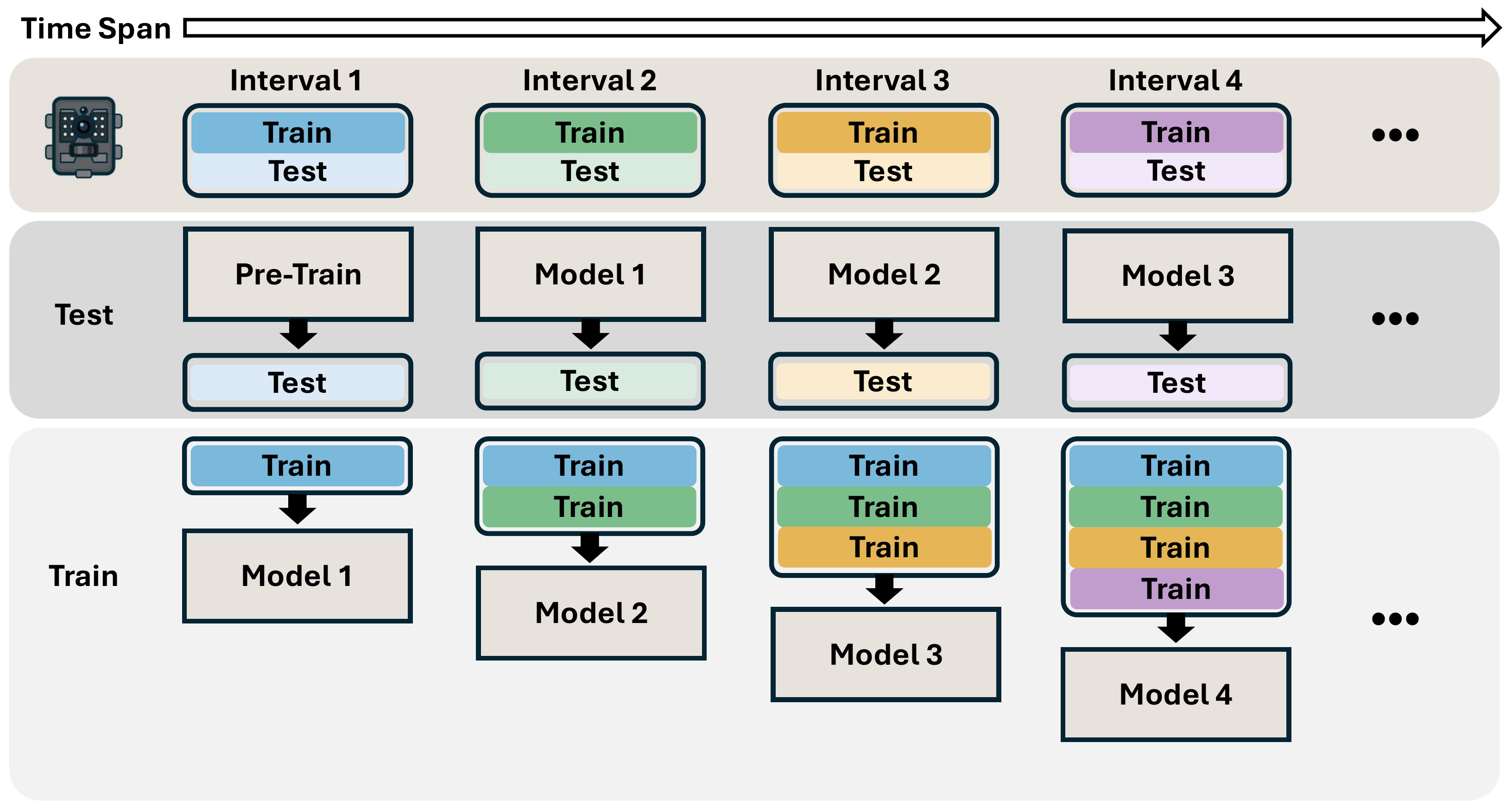
Unlike conventional benchmarks where all target data is available at once, StreamTrap mirrors how camera traps operate in the field. At each interval, a model is updated on everything seen so far — then evaluated on the next unseen interval. This chronological train-then-test loop is what makes naive fine-tuning surprisingly fragile.

Training and testing protocol across sequential camera-trap intervals

A benchmark built for diversity and difficulty

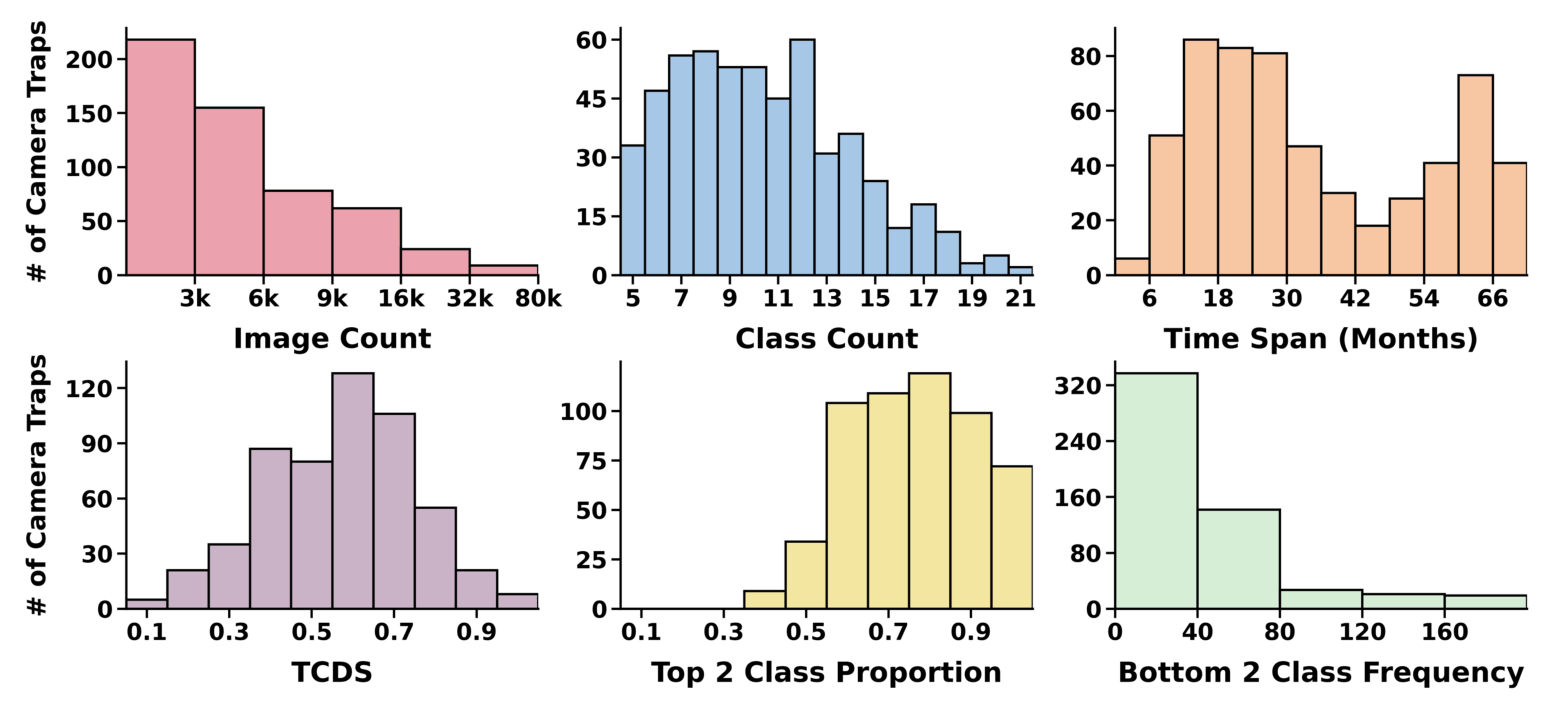
StreamTrap spans a wide range of conditions — from 6-month deployments to multi-year streams, from 5-class to 45-class ecosystems. The bottom row reveals the core challenge: high TCDS and extreme class imbalance are not edge cases but the norm.

StreamTrap dataset statistics

Key Findings


Four deployment-critical insights from our end-user-centric study

1

Adaptation is Still Required

BioCLIP 2's zero-shot accuracy varies widely across 546 sites — 161 exceed 90%, but 162 fall in the 50–80% range. Foundation models alone are insufficient; site-specific adaptation remains critical.

2

Naive Adaptation Can Hurt

Under realistic streaming evaluation, naive supervised fine-tuning on all accumulated data consistently underperforms zero-shot baselines by a large margin — even without any storage or computation constraints.

3

Two Compounding Drivers

Severe class imbalance (top-2 species average ~71% of images) and pronounced inter-interval temporal shift (TCDS) jointly create a compounding effect that makes continual adaptation exceptionally difficult.

4

Effective Recipes Exist, but Gaps Remain

BSM + LoRA yields substantial improvements and enables 474/546 sites to outperform zero-shot. Post-processing techniques further narrow the gap to oracle, but principled hyperparameter selection without future data remains open.

What makes temporal adaptation so hard?

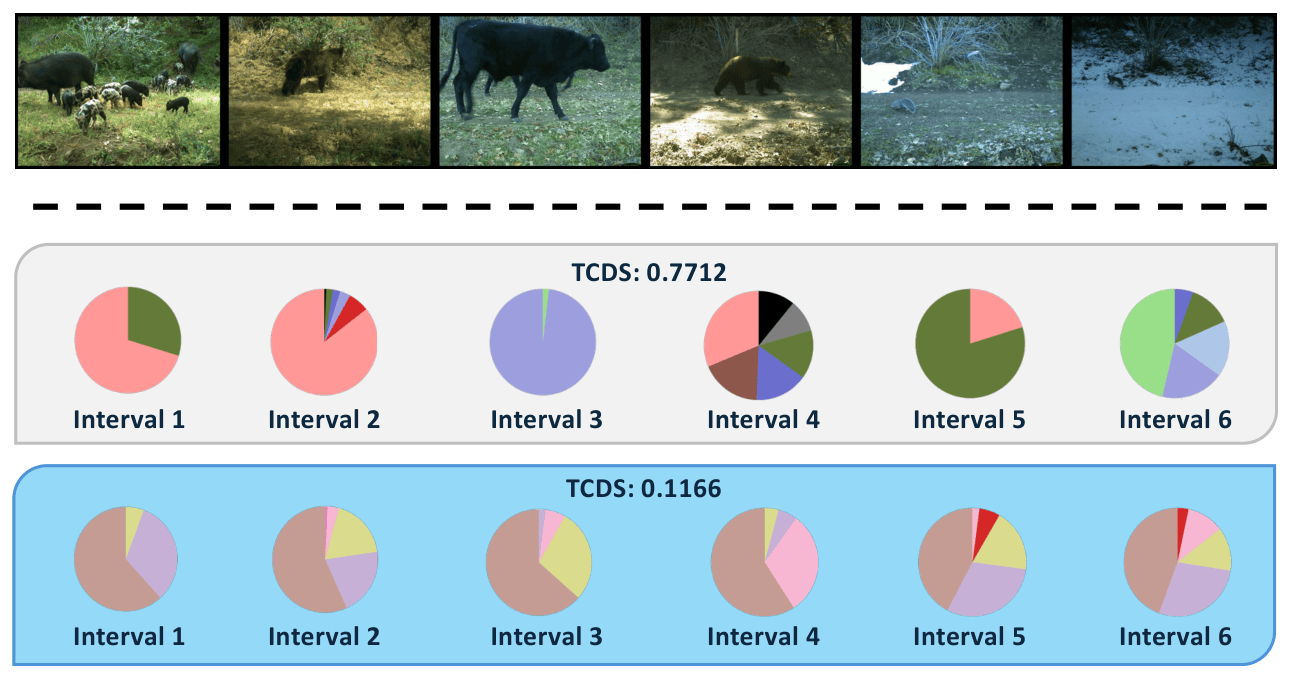
Camera traps passively wait for animals — so the training data is inherently lopsided, with a few dominant species accounting for the bulk of images. On top of that, ecosystems are non-stationary: the species that appeared frequently last season may barely show up next interval. We introduce TCDS to quantify this shift. The two rows of pie charts below illustrate it directly — a high-TCDS trap sees dramatically different species distributions across intervals, while a stable trap stays relatively consistent. A model that performed well on past data has no guarantee of performing well on the next interval.

Species distribution shift across time intervals

Temporal Class Distribution Shift (TCDS)

$$\text{TCDS} \coloneqq \overbrace{\dfrac{1}{n-1}\sum_{j=1}^{n-1}}^{\substack{\small\text{Average over} \\ \small\text{all intervals}}} \quad \underbrace{\sum_c \left| p_j^c - p_{j+1}^c \right|}_{\substack{\small\text{Class distribution} \\ \small\text{shift between intervals}}}$$

where $p_j^c$ is the normalized frequency of class $c$ at interval $j$. Higher TCDS means larger temporal shift.

Recommended Adaptation Recipe


A practical, first-to-try strategy for camera-trap deployment

Core Recipe (★)

BSM Loss + LoRA (PEFT)

Balanced Softmax (BSM) addresses severe class imbalance without hyperparameter tuning. LoRA preserves pre-trained representations while enabling efficient site-specific adaptation. Combined, they yield a compounding boost that enables 474 / 546 sites to outperform zero-shot.

Augment with post-processing:
Logit Calibration Weight Interpolation (WiSE) Interval Model Selection

Results


Are foundation models already sufficient?

Only at some sites. Zero-Shot BioCLIP 2 exceeds 90% accuracy at 161 camera traps, yet falls between 50–80% at another 162. This variability leaves a clear need for site-specific adaptation.

Zero-Shot

Per-class accuracy across 546 camera traps, ranked from highest to lowest

Above 90% 80–90% Below 80%
Ranked Zero-Shot per-class accuracy across 546 camera traps.

If Zero-Shot falls short, can we simply fine-tune?

The results show that fine-tuning alone is not enough. Naive accumulated fine-tuning can fall below Zero-Shot, and even Oracle fine-tuning—with temporal uncertainty removed—underperforms at 214 of 546 sites. Balanced Softmax with LoRA makes this adaptation substantially more reliable.

Oracle Fine-Tuning

Accuracy change relative to the same Zero-Shot baseline

Adaptation performs better Zero-Shot remains better

Oracle − Zero-Shot

Change in per-class accuracy from Zero-Shot to Oracle.
Apply our recipe

Oracle★ − Zero-Shot

Change in per-class accuracy from Zero-Shot to Oracle star.

Does the robust recipe work in realistic streaming deployment?

The recipe transfers well to this realistic streaming setting. Across these representative sites, Accum★ recovers the large losses of naive Accum and consistently surpasses Zero-Shot. A gap to Oracle★ remains, revealing the challenge of adapting to future shifts without access to future labels.

20-Camera Results

Per-class accuracy (%) across 20 representative camera traps.

ΔDifference from Zero-Shot Decrease from Zero-Shot Improvement over Zero-Shot
Camera Index C1C2C3C4 C5C6C7C8 C9C10C11C12 C13C14C15C16 C17C18C19C20 Avg
Zero-Shot 97.792.390.989.186.1 84.381.581.278.377.1 75.873.870.169.867.1 66.062.261.556.355.8 75.8
Accum 73.677.150.071.746.7 33.356.773.045.025.0 57.050.068.260.866.7 11.461.758.033.345.7 53.2
Δ 24.115.240.917.439.4 51.024.88.233.352.1 18.823.81.99.00.4 54.60.53.523.010.1
Accum★ 98.789.989.990.879.4 79.283.488.381.078.7 76.970.179.475.486.9 76.688.971.376.782.6 82.2
Δ 1.02.41.01.7 6.75.11.97.1 2.71.61.13.7 9.35.619.810.6 26.79.820.426.8
Oracle★ 98.796.494.596.687.8 91.591.091.087.382.0 84.388.591.086.691.0 83.993.889.689.993.4 90.4
Δ 1.04.13.67.51.7 7.29.59.89.04.9 8.514.720.916.823.9 17.931.628.133.637.6

Open Questions


Critical deployment questions largely underexplored by the vision community

When is zero-shot sufficient?

Before any data collection, practitioners need to predict whether a foundation model will be accurate enough at a new site. OOD confidence signals (MSP) show positive but weak correlation (r = 0.907) with zero-shot accuracy — insufficient for reliable deployment decisions.

Is continual adaptation necessary?

Model accuracy generally increases with more intervals of adaptation, but not all updates are equally valuable. Freezing a model after 75% of intervals already achieves 82.7% vs. 84.9% for full adaptation — motivating selective updating.

When should we adapt? (Adapt-or-Skip)

At every interval, practitioners face the Adapt-or-Skip decision before seeing future data. MSP-based and CLIP feature-based heuristics both perform close to random guessing (~47–48% accuracy). An oracle always selecting the correct action outperforms baselines by 11.34% — substantial room for future research.

BibTeX


@inproceedings{jeon2026streamtrap,
  title={Lessons and Open Questions from a Unified Study of
         Camera-Trap Species Recognition Over Time},
  author={Jeon, Sooyoung and Tian, Hongjie and Wang, Lemeng and
          Mai, Zheda and Bakshi, Vidhi and Hou, Jiacheng and
          Zhang, Ping and Chowdhury, Arpita and Gu, Jianyang and
          Chao, Wei-Lun},
  booktitle={European Conference on Computer Vision (ECCV)},
  year={2026}
}